
19 November 2026
Design, Construction or Turnkey: Which Does Your Temple Committee Need?
By Y. Sompura
Before a single stone is carved, a temple trust has to decide who will draw the temple and who will build it. The answer shapes who is responsible when something goes wrong, how the cost is built up and how much control the committee keeps. Owners of every kind of building face this choice, and the sound approach is to pick the method that fits the project, not the one they happen to know.
For temples there are three common routes: design-only, construction-only and turnkey. We have worked in all three, and none is right for every trust. This article explains each one with projects we have done, sets them side by side, and ends with questions a committee can ask before it signs.
Design-only
In a design-only commission, the firm prepares the temple’s design, planning and architectural detailing, and the trust appoints its own builder. It is close to what the construction literature calls design–bid–build, where the owner signs separate agreements with the designer and the builder and chooses the builder on the finished drawings (American Institute of Architects [AIA] & Associated General Contractors of America [AGC], 2023).
At Becharaji, the old Bahuchar Mata Mandir has been dismantled and a new temple is rising on the same site to our design, for the Bahuchraji Mata Trust. At Saldi, we designed the new Pipleshwar Mahadev Mandir in 2018 around the original Shivalinga. At Vesu, Surat, we designed and detailed the Kalyan Shwetambar Jain Derasar, and at Siddhpur the Sultan Parshwanath Jain Tirth, completed in 2017 (see Figure 1).
Figure 1
A White Marble Temple Designed by Our Firm: Sultan Parshwanath Jain Tirth, Siddhpur
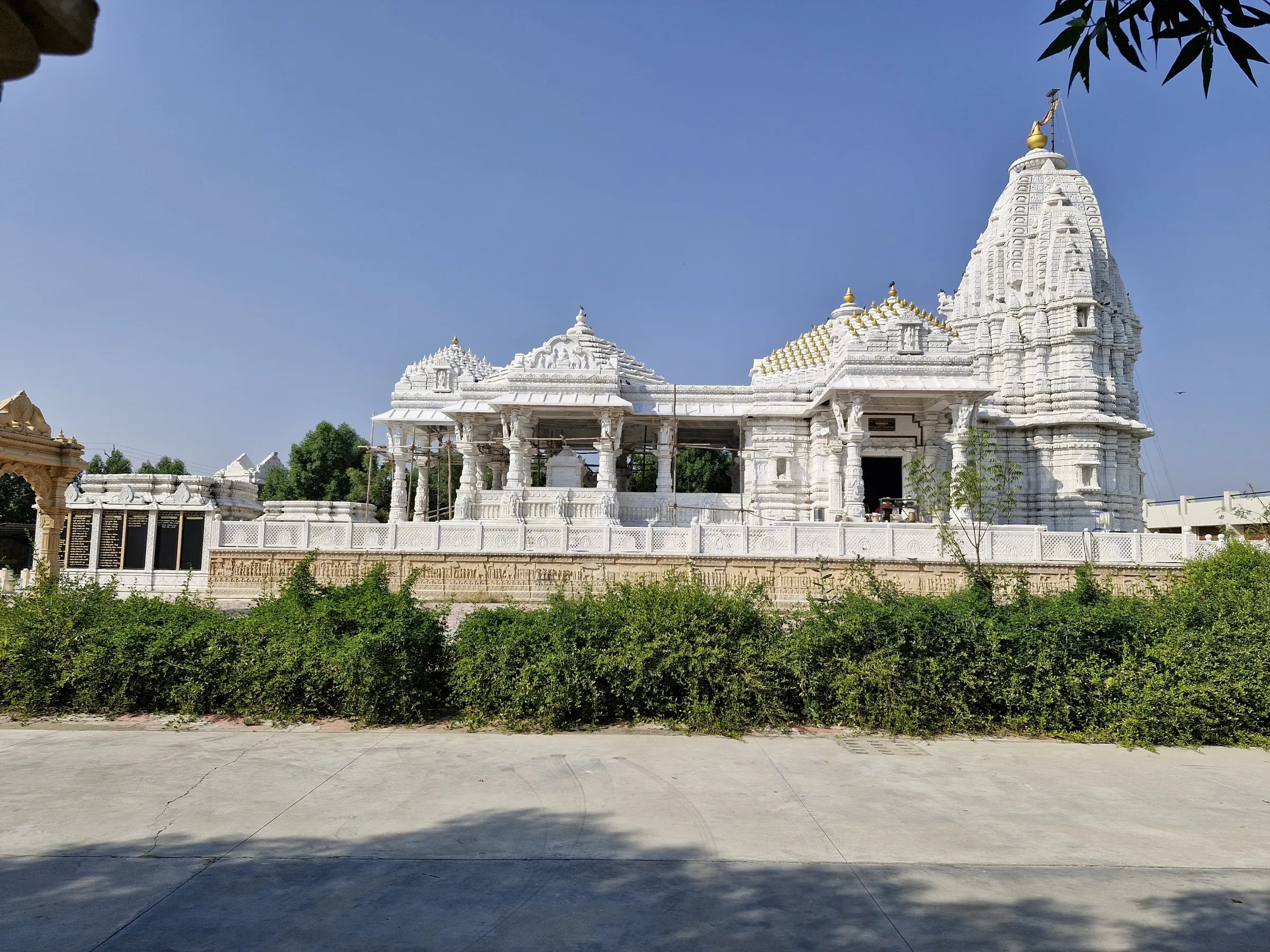
Note. Designed for the Shree Siddhidayak Sultan Parshwanath Jain Trust. Photograph from the Sompura Marble Industries project archive.
This route suits a trust that already has a contractor it trusts. The trust keeps close control, and competitive bidding tests the price. The risk sits at the handover. With separate contracts, any gap or error in the drawings falls on the trust, and in a temple the drawing has to be carved exactly as drawn. Choose a builder with a good record in temple work.
Construction-only
Here the design already exists, and the firm carves, transports and installs the stone. A temple is not made by one pair of hands: a large project can occupy hundreds of artisans (Sompura, 2026), so a fixed drawing and a clear chain of command matter.
At Ayodhya, Larsen & Toubro was the main contractor and Chandrakant Sompura the chief architect. From 2020 to 2026 we were one of the stone sub-contractors, carving, transporting and installing about 180,000 cubic feet for the main temple, 70,000 for the corridor and 6,500 for the Saptarishi temple. At Khodal Dham, Kagvad, about 230,000 cubic feet of pink Bansi Paharpur stone went into the temple, and we carved, transported and installed 50,000 of it (see Figure 2). At Amba Ji, we built the 8,600-cubic-foot rang mandap, completed in 2008.
Figure 2
Pink Bansi Paharpur Stone at Khodal Dham, Kagvad, Carved and Installed in Part by Our Firm

Note. Our share was 50,000 of about 230,000 cubic feet. Photograph from the Sompura Marble Industries project archive.
This route suits a project with a fixed design and a main contractor who coordinates with the designer. Its weak point is matching. When several firms supply one temple, colour, texture and carving style have to stay consistent across thousands of blocks.
Turnkey
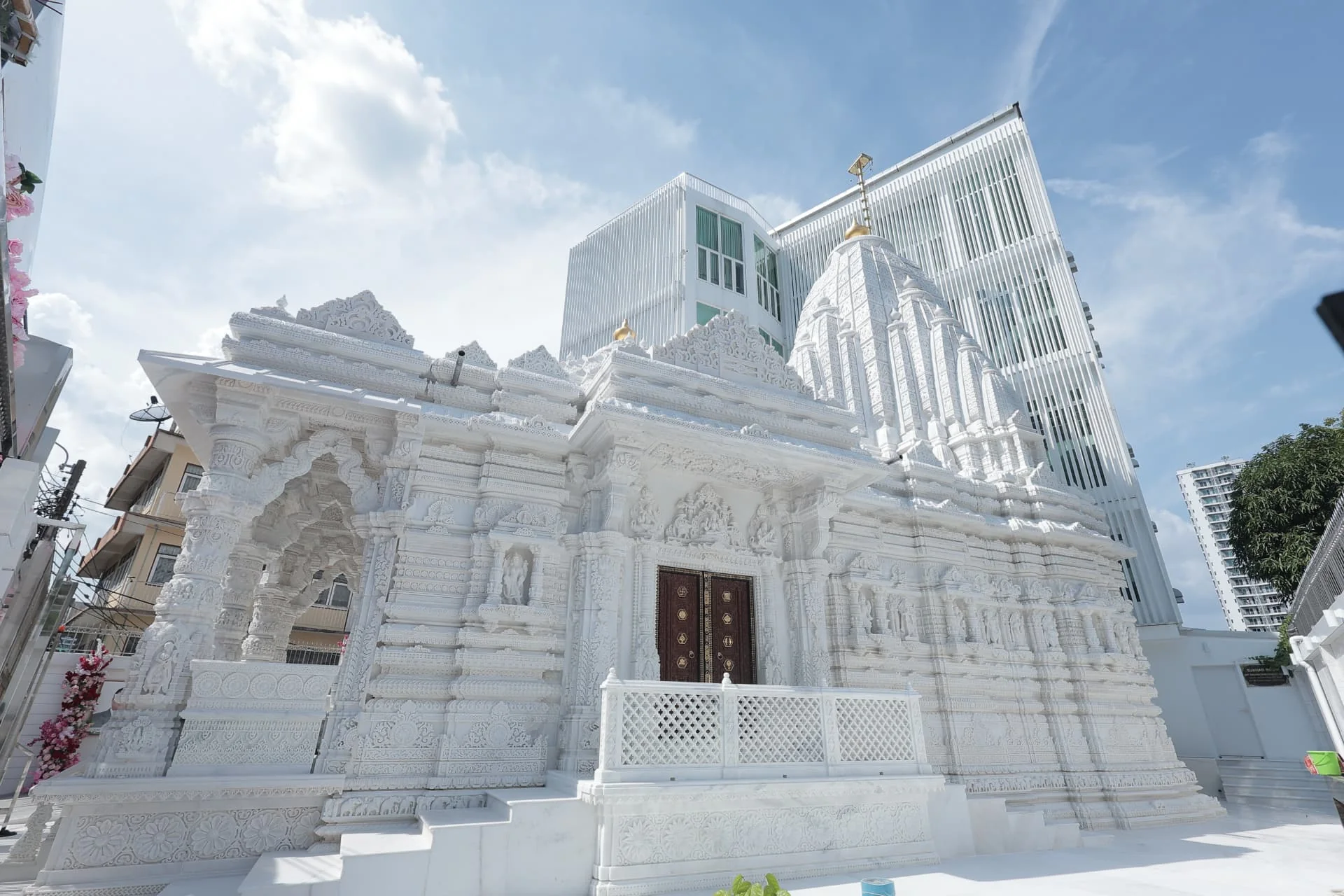
In a turnkey commission, one firm designs, carves, transports and installs. The owner deals with one party that answers for both design and construction, which is the main attraction of the design/build model (AIA & AGC, 2023). We delivered the Sambhavnath Jain Derasar in Bangkok this way in 2024, for the Thai Jain Association (see Figure 3). The same model produced the Ratna Chintamani 52 Jinalay at Navsari, a 35,000-cubic-foot complex finished in 2002, and the Shiv and Ganpati Mandir at Reliance Greens, Jamnagar, in 2025.
Figure 3
Sambhavnath Jain Derasar, Bangkok, Designed, Carved and Installed by One Firm
Note. Completed in 2024 for the Thai Jain Association. Photograph from the Sompura Marble Industries project archive.
This route suits a trust that wants one point of responsibility, or a site far from the workshop. Abroad, carved stone is made at home, numbered, packed and shipped, so the accuracy of the drawing decides whether the pieces fit on arrival. There are trade-offs. The owner gives up some control over details the contract leaves open, and Hosie (2007) cautions that true single-point responsibility is hard to achieve in practice. Ask to see how the cost is built up.
The three routes side by side
Table 1
Comparison of the Three Routes
| Route | Who designs | Who builds | Best when |
|---|---|---|---|
| Design-only | Our firm | The trust’s own builder | The trust has a contractor it trusts |
| Construction-only | The trust’s architect | Our firm | The design is fixed and a main contractor coordinates |
| Turnkey | Our firm | Our firm | The trust wants one responsible party, or the site is far away |
Note. Based on our own projects.
Five questions to ask before you decide
- Who holds the drawings, and who may change them?
- Who is responsible if a carved piece is damaged on site?
- How far is the site from the workshop, and who handles transport and installation?
- Will the work happen in phases, with funds arriving over years?
- Do you already have an architect or a main contractor?
Conclusion
There is no single right answer. Design-only keeps control with the trust and puts the weight on the builder. Construction-only fits a fixed design with a main contractor in charge. Turnkey gives one point of responsibility and asks the trust to place the whole job with one firm. The choice is best made early, while the drawings, the budget and the funding are still open. If you are weighing these options for a temple, write to us through the Contact page with the site, the community and the stone you have in mind. You can also browse all our projects.
References
American Institute of Architects & Associated General Contractors of America. (2023, December 6). A primer on project delivery terms. https://www.aia.org/resource-center/primer-project-delivery-terms
Hosie, J. (2007, August). Turnkey contracting under the FIDIC Silver Book: What do owners want? What do they get? (Paper D083). Society of Construction Law. https://www.scl.org.uk/papers/turnkey-contracting-under-fidic-silver-book-what-do-owners-want-what-do-they-get
Sompura, Y. (2026). A resilient tradition. katte, 2, 112–117.